

Why Faulty Rainwater Management Destroys Exterior Masonry
When homeowners think about roof maintenance, they usually picture slipped slates, damaged lead flashing, or flat roof leaks. However, one of the most destructive threats to your home’s structural integrity isn’t on top of the roof—it’s mounted along the eaves and down the walls.
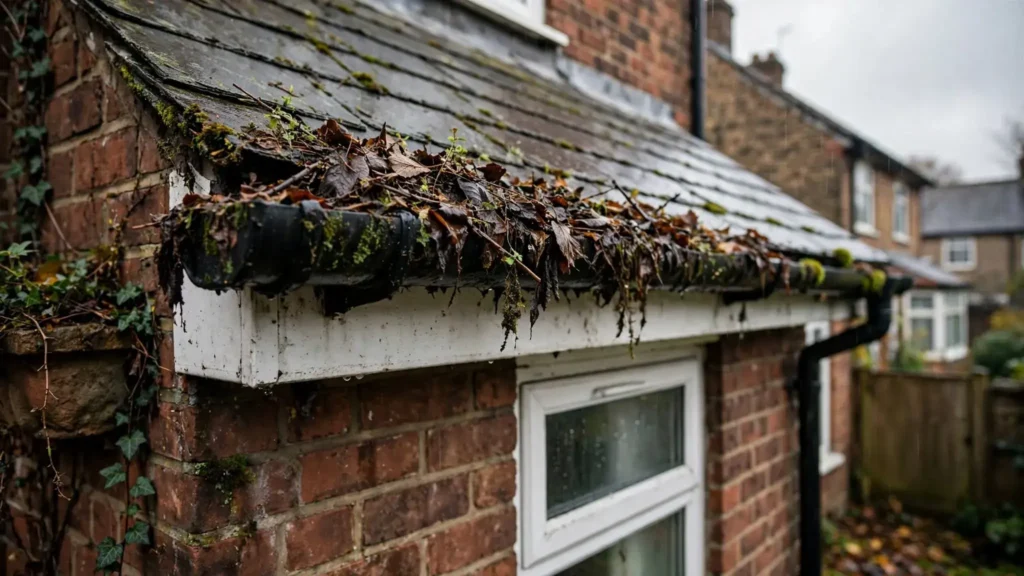
Your rainwater management system (gutters, downpipes, hopper heads, and valleys) is responsible for collecting hundreds of gallons of water during heavy downpours and directing it safely away from your property. When this system fails due to clogs, cracks, or loose fittings, water cascades directly down your external walls.
Over time, this unmanaged runoff saturates exterior brickwork, compromises damp-proof courses, and causes severe internal penetrating damp. Here is an exploration of the knock-on effects of faulty rainwater management and why fixing guttering issues is vital for your home’s structural health.
The Saturation Effect: How Water Penetrates Brickwork
Contrary to popular belief, brickwork and mortar are not completely waterproof. Traditional building materials—especially porous red bricks and lime or sand-cement mortar beds—act like a dense, heavy sponge.
- Saturated Masonry: Under normal conditions, rainfall hits a wall at an angle and quickly evaporates in the breeze. However, when an overflowing gutter or a cracked downpipe pours a continuous, heavy stream of water onto a concentrated section of brickwork, the masonry reaches its point of saturation.
- Frost Spalling (Freeze-Thaw Cycle): During North West winter snaps, trapped water within saturated bricks freezes and expands. This internal pressure causes the face of the brick to crack, flake, or pop off entirely—a destructive process known as spalling. Once the hard outer skin of the brick is lost, the softer interior core degrades rapidly.
- Mortar Washout: Continuous water flow dissolves mortar joints over time, causing pointing to crumble and fall out. This opens up wide pathways for wind-driven rain to penetrate deeper into the wall cavity.
Bridging the Damp-Proof Course (DPC)
Every house features a Damp-Proof Course (DPC)—a physical barrier (such as plastic, bitumen, or slate) built into the lower wall structure, at least 150mm above ground level, to stop ground moisture from rising upwards into the living space.
Faulty rainwater systems frequently bypass or “bridge” this crucial barrier:
- Splattering at Ground Level: When a downpipe splits at the base or a gutter overflows from a high roofline, water cascades straight down to the paving, driveway, or soil below.
- Heavy Splashback: This continuous stream splashes soil, water, and debris high up onto the lower brickwork—well above the 150mm DPC line.
- Moisture Bypass: Because the brickwork above the DPC becomes thoroughly soaked from the splashback, moisture bypasses the physical barrier completely and trickles horizontally into internal floor joists, skirting boards, and interior plasterwork.
Penetrating Damp vs. Rising Damp: Spotting the Signs
When rainwater management fails, the result inside your home is penetrating damp. Homeowners often mistake this for rising damp or simple room condensation, leading to incorrect and expensive non-cures.
|
Symptom |
Penetrating Damp (Rainwater Issue) |
Rising Damp (Failed DPC) |
|
Location |
Can appear anywhere on internal walls—often corresponds to gutter levels, hopper heads, or downpipe brackets outside. |
Strictly confined to the lower wall (up to ~1 metre above floor level). |
|
Appearance |
Spreading, dark wet patches that grow larger immediately after heavy rain; peeling wallpaper; damp plaster. |
Horizontal “tide marks” near the floor, salt deposits (efflorescence), rot on skirting boards. |
|
External Cause |
Overflowing guttering, leaking downpipe joints, cracked render, or defective pointing. |
Missing, damaged, or bridged damp-proof course at ground level. |

Protecting Your Masonry: A Proactive Checklist
Preventing thousands of pounds in masonry repairs and internal damp treatments starts with simple, regular maintenance of your rainwater infrastructure:
- Clear Gutters Twice a Year: Remove leaves, moss, and silt in late autumn and late spring. A single blocked outlet can cause an entire gutter run to back up and spill water down your masonry.
- Inspect Downpipe Brackets & Joints: Ensure downpipes are securely fastened to the wall. Loose downpipes rattle in wind and break at the joints, letting water run down the wall hidden behind the pipe itself.
- Check for Wall Staining: Walk around your home during or immediately after a heavy rainstorm. Look for telltale dark patches, green algae streaks, or white salt marks on external brickwork—these indicate a hidden leak above.
- Ensure Proper Outlets & Gulley Clearance: Make sure downpipes discharge directly into a clear gully grate rather than emptying onto surrounding paving or soil where water can pool against the foundations.
Keep Your Home Watertight
A failing gutter or a split downpipe might seem like a minor cosmetic annoyance, but left unchecked, unmanaged rainwater will silently destroy your exterior brickwork and ruin internal finishes.
If you notice overflowing gutters, crumbling mortar, or damp patches appearing on your walls, Lords Roofing provides complete guttering repairs, uPVC fascia and soffit upgrades, and full roofline replacements to keep your home completely protected.